
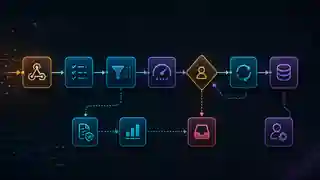
A controlled enquiry workflow needs more than a trigger and a reply node. In an n8n-style design, every message should receive a correlation ID, pass schema validation, follow an explicit risk state, and either complete with an audit trail or enter a visible exception path.
This is a technical design pattern for Singapore SMEs connecting forms, email, messaging platforms and internal systems. Low-code reduces assembly work; it does not remove responsibility for credentials, data handling, testing, monitoring or business approvals.
Define channel constraints before drawing nodes
List each intake channel and its limits. A web form can enforce required fields before submission. Email is less structured and may include attachments, forwarded threads or spoofed sender details. A business messaging platform may require an approved API, templates, consent or response-window rules. Do not design against a personal chat session or an unofficial connector simply because it is convenient.
For each connector, document:
- supported authentication method and credential owner;
- payload shape, attachment limits and event identifiers;
- delivery semantics, including whether events can arrive more than once or out of order;
- rate limits and expected peak volume;
- data retained by the channel, connector and workflow platform;
- how a failed intake becomes visible to staff.
Separate channel capture from business processing. A thin intake workflow can verify the source, preserve the provider event ID, assign a correlation ID and place a normalised message on an internal queue. Downstream logic then works from one contract instead of several channel-specific payloads.
Create a canonical enquiry schema
Define a versioned internal object rather than passing raw connector output through every node. A practical schema might include correlation_id, source_channel, source_event_id, received_at, customer_reference, contact_method, enquiry_type, message_text, attachment_refs, consent_context, risk_state and schema_version.
Validation should distinguish three outcomes:
- Valid: the minimum contract is present and processing can continue.
- Recoverable: a non-sensitive field is missing and an approved request-for-information step may be used.
- Invalid or unsafe: the source cannot be verified, the payload is malformed, an attachment is unsupported, or the workflow cannot safely determine the next step. Send it to an exception queue rather than guessing.
Store the raw payload only when there is a defined operational need, access control and retention rule. Otherwise retain the minimum fields required for processing and audit. Do not copy attachments or full message bodies into every execution log.
Make retries idempotent
Connectors retry. Users double-submit. A worker can time out after sending a message but before recording success. Without idempotency, one enquiry can produce duplicate acknowledgements, records or tasks.
Generate an idempotency key from a stable provider event ID where available. If the source has no suitable ID, use a carefully defined fingerprint that combines a channel identifier, sender reference, bounded time window and normalised payload hash. A fingerprint can produce false matches, so document its limits and allow manual review.
Before a side effect, check an idempotency store with a uniqueness constraint. Record started, completed or failed_unknown against the key. Do not treat a network timeout as proof that the remote action failed. Query the target system by correlation ID or send the item to review before repeating a commitment.
Carry the same correlation ID through workflow runs, approval tasks, CRM records and outbound messages. That one identifier makes investigation far easier than matching timestamps by eye.
Use a risk state machine, not scattered IF nodes
Model permitted transitions explicitly. An example state set is:
RECEIVED→ captured but not validated;NEEDS_INFORMATION→ required fields are missing;STANDARD_REVIEW→ valid, routine and ready for a defined rule;HUMAN_APPROVAL→ a commitment, exception or sensitive case needs an authorised decision;READY_TO_SEND→ approved content and destination are fixed;COMPLETED→ side effects verified and audit event written;EXCEPTION→ processing stopped with an owner and reason;CANCELLED→ deliberately closed without further action.
Put transition rules in one place. A message should not jump from RECEIVED straight to READY_TO_SEND because a branch was added later. Save the previous state, new state, rule version and actor for every transition.
Place human approval before commitments
Human approval nodes are appropriate before custom quotes, discounts, availability promises, refunds, unusual scheduling, contract changes or exceptions to policy. The approval task should display the original request, validated fields, proposed action, policy reference and expiry time. The reviewer needs clear options: approve, reject, request information or escalate.
Bind approval to a content hash or immutable version. If the proposed reply or commercial detail changes after approval, invalidate the approval and request a new decision. Record reviewer identity, decision, timestamp and reason. Approval links should expire and require authenticated access; do not place customer data or one-click approval secrets in ordinary email text.
Design failure paths before the happy path
Exception queue
Every unhandled branch should create a structured exception containing correlation ID, stage, safe error code, retry count, first-seen time, last-seen time and assigned owner. Avoid placing credentials, tokens or full sensitive payloads in error messages. Staff need a filtered work queue, not a mailbox full of stack traces.
Timeouts, retry and backoff
Set an explicit timeout for each network operation. Retry only errors that may be temporary, such as a rate limit or service-unavailable response. Use exponential backoff with jitter and a maximum attempt count. Validation failures, authentication failures and rejected business rules usually need correction or escalation, not repeated traffic.
Dead-letter handling
After the retry budget is exhausted, move the item to a dead-letter queue with the last safe error, workflow version and replay requirements. Replaying should be a controlled action that checks idempotency first. A dead-letter queue without an owner, service target and review routine is just hidden failure storage.
Manual fallback
Document how staff continue when automation is paused. The fallback should state where new enquiries are seen, how ownership is assigned, which approved templates may be used, how commitments are authorised, and how manually completed cases are reconciled when the workflow returns.
Keep credentials outside the workflow definition
Use the platform’s credential store or an approved secrets manager. Grant each connector only the scopes its nodes require. Separate development and production credentials, restrict who can view or change them, and record rotation ownership. Do not paste API keys into code nodes, environment screenshots, exported workflow JSON or support tickets.
Minimise data at every boundary. If routing needs only an enquiry category and contact reference, do not send the full conversation to an unrelated system. Configure execution-data retention deliberately and test whether failed runs expose more content than successful runs. Redact or hash identifiers in metrics where operational analysis does not require the original value.
Emit useful audit events and metrics
An audit event should answer what happened without becoming a second copy of the enquiry. Record correlation ID, event type, workflow version, node or service, actor type, outcome, reason code and timestamp. Protect audit records from routine editing and define who can access them.
Operational metrics can include intake volume, validation failures, duplicate suppression, approval age, retry count, dead-letter count and end-to-end completion time. Set alert ownership for conditions that need action, such as a rising exception queue, expired approvals, credential failures or zero intake during expected business periods. Dashboards do not replace alerts, and alerts do not replace an owner.
Test cases that expose weak designs
- The same provider event arrives twice within seconds.
- Two messages share similar text but are genuinely different enquiries.
- A required field is blank, malformed or unexpectedly long.
- An attachment type is unsupported or cannot be scanned by the approved process.
- The target record is created, but the connector times out before returning success.
- An approval expires, is rejected, or refers to an outdated proposal.
- A rate limit triggers several retries and then recovers.
- Credentials are revoked while items are in flight.
- The dead-letter queue is replayed after the target system already completed the action.
- The workflow is paused and staff switch to the manual fallback, then reconcile completed cases.
Use synthetic records in development. In a pre-production environment, test permissions, retention, alert delivery and rollback as well as functional output.
Deploy with change control and rollback
Export a versioned workflow definition with secrets excluded. Record the schema version, node dependencies, credential references, migration steps, test evidence, approver and rollback version. Promote the same reviewed version through environments rather than rebuilding nodes manually in production.
For a risky change, run in shadow mode first: process a copy of the event without sending customer-facing output, then compare the proposed state and routing with expected results. A canary rollout can limit a new version to one channel or a small share of traffic. Rollback should restore the previous workflow and schema behaviour without replaying completed side effects.
Technical ownership is the lasting control
n8n can make this pattern visible and maintainable, but the platform does not decide the SME’s approval policy, retention rules or acceptable failure behaviour. Assign a named technical owner and a named business owner, review exceptions, rotate credentials, test fallback procedures and retire unused connectors.
Sakal Network outlines its n8n automation service for Singapore businesses for teams that need implementation and operational support. The separate Sakal enquiry-automation article is still in review, so its primary contextual link will be added only after a verified published URL exists.